
The Six Hidden Engines of Workplace Motivation

Most leaders want motivated people. They want people who care, show up, take ownership, solve problems, bring energy, and do more than simply check the box. But too often, leaders make one major mistake: they assume everyone is motivated by the same thing.
Money, pressure, recognition, opportunity, purpose, and stability can all matter. But they do not matter to everyone in the same way. Some people are not lazy, checked out, or impossible to lead. They may simply be running on a different fuel than the one their leader keeps trying to use.
That is where real leadership begins. Not with the question, “How do I make people work harder?” but with a better one: “What actually moves this person?”
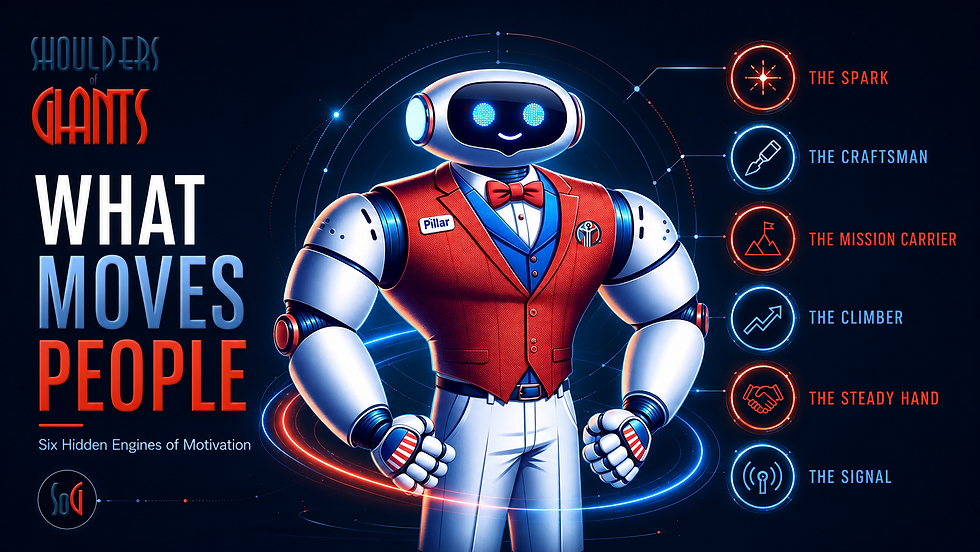
At Shoulders of Giants, we believe leadership is not about standing above people. It is about helping people stand taller. To do that, leaders have to pay attention. Here are six hidden engines of workplace motivation.
1. The Spark
The Spark is moved by energy. They thrive on momentum, challenge, competition, and big goals. They bring excitement to a team and come alive when there is something worth chasing. In the workplace, this may be the person who jumps into a new product launch, rallies the team around a challenge, and brings life into the room when the energy is flat.
But Sparks need direction. A weak leader gives them hype without structure. A strong leader gives them a real hill to climb with clear goals, honest feedback, and healthy competition. The Spark can light up a room, but leadership’s job is to make sure the fire has somewhere useful to go.
2. The Craftsman
The Craftsman is moved by progress. They care about doing things well and take pride in quality, ownership, and improvement. They may be the person refining a proposal, improving a process, or making sure the work is accurate, polished, and effective before it goes out the door.
A weak leader kills The Craftsman’s motivation through micromanagement, constant changes in direction, or acting like quality does not matter. A strong leader gives them trust, standards, and responsibility. The Craftsman does not just want tasks. They want to build something that lasts.
3. The Mission Carrier
The Mission Carrier is moved by belief. They need to know why the work matters. When they believe in the mission, the brand, the leader, or the team, they become deeply loyal and committed. This is the person who stays engaged through difficult seasons because they understand the larger purpose behind the work.
But belief cannot be faked. A weak leader relies on slogans. A strong leader lives the message, communicates clearly, and connects daily work to a bigger purpose. The Mission Carrier reminds us that people do not only want instructions. They want meaning.
4. The Climber
The Climber is moved by opportunity. They want growth, achievement, advancement, and a clear path forward. This is the person asking for feedback, seeking stretch assignments, and trying to understand what skills or results are needed to reach the next level.
A weak leader offers vague promises and no real direction. A strong leader creates opportunities, sets expectations, and challenges The Climber to earn the next step. Ambition is not the enemy. When guided well, it becomes a powerful force. The Climber does not want to stand still, and if there is no path forward, they will eventually find one elsewhere.
5. The Steady Hand
The Steady Hand is moved by stability. They value consistency, fairness, respect, and clear expectations. They may not seek attention, but they are often the people holding everything together. During busy seasons, they are the dependable ones keeping processes moving, meeting deadlines, and helping others stay organized.
A weak leader overlooks them because they are not loud about what they need. A strong leader values them before they are missed. The Steady Hand may never demand recognition, but take them for granted long enough, and you will feel the difference.
6. The Signal
The Signal is moved by recognition. They want to be seen, included, and valued. This is not always about praise or ego. Sometimes it is simply about knowing their contribution matters. After a successful project, The Signal feels energized when their specific role and impact are acknowledged instead of being lost inside a general team win.
A weak leader only notices The Signal when something goes wrong. A strong leader gives specific, genuine recognition. Recognition is feedback. It tells people, “Your effort matters here.” For The Signal, being seen can be the difference between quietly holding back and fully stepping forward.
The Real Lesson
Most people are not just one of these. People are layered. A person can be a Spark in one season and a Steady Hand in another. Someone can be a Climber and still need recognition. Someone can believe deeply in the mission and still want to be paid fairly.
That is why leadership cannot be lazy. It is easy to say, “People just do not want to work anymore.” It is harder, and much more useful, to ask, “Have I taken the time to understand what moves them?”
Money matters. People have bills, goals, families, and responsibilities. Compensation is part of respect. But money alone does not create lasting motivation. A paycheck can buy someone’s time, but it does not automatically earn their best. Their best usually comes from something deeper: pride, belief, opportunity, stability, recognition, ownership, and trust.
The best leaders are students of people. They watch, listen, and ask better questions. They learn who needs momentum, who needs ownership, who needs belief, who needs opportunity, who needs consistency, and who needs recognition.
Standards still matter. Accountability still matters. Results still matter. But accountability works better when it is connected to what actually drives the person receiving it.
The Spark needs momentum. The Craftsman needs ownership. The Mission Carrier needs belief. The Climber needs opportunity. The Steady Hand needs consistency. The Signal needs recognition. And all of them need leadership that is awake enough to know the difference.
At the end of the day, leadership is not just getting people to work harder. It is learning what makes people come alive. And when people come alive, the work changes, the culture changes, and the results change.
That is the power of understanding what moves people.
That is leadership built on stronger shoulders.


Comments